Isolation could be counterproductive as Kabul sits at a geopolitical chokepoint
Five years after the Taliban returned to power in Afghanistan, the world faces an uncomfortable reality: isolation has neither transformed the regime nor improved the lives of ordinary Afghans.
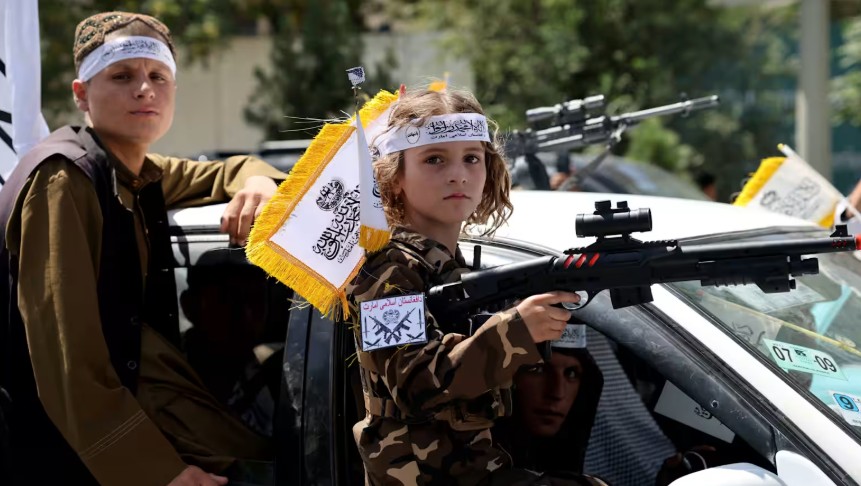
When Taliban fighters entered Kabul on Aug. 15, 2021, many governments hoped diplomatic isolation, sanctions and international pressure would compel the new authorities to moderate their behavior. Instead, Afghanistan has entered a prolonged period of political exclusion, economic fragility and humanitarian dependence, while the Taliban leadership has consolidated control over state institutions.
While the question of international legitimacy remains important, it is not the only consideration shaping Afghanistan’s future. Their record on human rights, particularly women’s rights, remains deeply troubling. More importantly, it is worth asking whether isolation has altered Taliban behavior or simply weakened international leverage at the cost of worsening hardships faced by millions of Afghans.
Afghanistan today presents a paradox. The economy has shown limited signs of stabilization after years of collapse. Its gross domestic product grew by 2.5% in 2024 and expanded by 4.3% in 2025, supported by stronger domestic revenue collection, trade recovery and exchange-rate stability. Domestic revenues reportedly reached nearly 19.8% of GDP, reflecting the Taliban administration’s ability to maintain basic state functions.
However, these figures should not be mistaken for recovery. Rapid population growth means GDP per capita continues to decline, and Afghanistan remains one of the world’s poorest countries. According to the Office for the Coordination of Humanitarian Affairs (OCHA), more than 21 million Afghans are expected to require humanitarian assistance in 2026. The United Nations’ humanitarian appeal, seeking approximately $1.7 billion, has remained significantly underfunded, leaving aid agencies struggling to provide food, healthcare and emergency support.
The humanitarian crisis has been further intensified by the return of millions of Afghans from neighboring countries. The United Nations High Commissioner for Refugees (UNHCR) estimated that nearly 2.9 million returnees arrived in 2025 alone, primarily from Pakistan and Iran, adding pressure to a labor market already unable to absorb its young population.
Beneath the fragile recovery lies a deeper political and social crisis. The Taliban’s restrictions on women and girls remain a fundamental obstacle to international engagement. Around 2.4 million Afghan girls have been denied access to secondary and higher education. More than 100 restrictions affecting women’s participation in public life, employment, mobility and education have been introduced since 2021. According to UN Women, many Afghan women now rarely leave their homes, creating what the organization describes as a profound erosion of women’s social and economic participation.
These policies are not only a human rights tragedy, but also an economic constraint. A country with a young population cannot achieve sustainable development while excluding half of its citizens from education and formal economic activity.
However, the failure of the Taliban’s domestic policies does not automatically prove that international disengagement is the right response.
History suggests that isolation rarely changes authoritarian systems unless accompanied by credible alternatives and sustained diplomatic leverage. In many cases, isolation can strengthen hard-line factions by reducing external influence and limiting channels for dialogue.
Even Western governments, while refusing formal recognition, have maintained diplomatic channels and humanitarian engagement. This emerging pattern reflects a geopolitical reality: Afghanistan cannot simply be removed from the international system. It sits at the intersection of South Asia, Central Asia and the Middle East, where instability affects migration flows, terrorism risks, trade corridors and energy connectivity. Rather than viewing the debate as a binary choice between recognition and isolation, policymakers should consider a third approach: structured, conditional engagement.
Such an approach would not mean accepting Taliban policies or granting unconditional legitimacy. Instead, it would mean using engagement as a tool to pursue measurable outcomes. International actors should link economic cooperation, development assistance and diplomatic normalization to specific benchmarks: ensuring humanitarian access, preventing terrorist groups from operating freely, and improving governance transparency. This must be a gradual and realistic approach with the expectation that it may ultimately lead to reopening schools for girls, expanding women’s participation in public life.
From Kabul to Tehran, the lesson for the West is ideological doctrines cannot be overnight displaced by either sanctions or military intervention.
With appropriate safeguards, international involvement can support sectors that directly benefit ordinary citizens, including agriculture, healthcare, digital infrastructure and small businesses. Cutting Afghanistan off from global economic networks risks worsening poverty without necessarily changing government behavior. Critics argue that engagement rewards the Taliban. But there is a difference between recognition and engagement, between accepting a government’s actions and maintaining the ability to influence them.
Diplomacy has often required dealing with governments whose behavior is questionable. The purpose of diplomacy is not to reward governments; it is to protect interests, reduce risks and create possibilities for change. Five years after the Taliban takeover, the international community should ask whether its current strategy has maximized its leverage. If the objective is a more stable, secure and inclusive Afghanistan, then a policy that limits communication and influence may ultimately be counterproductive.
Afghanistan does not need another cycle of abandonment followed by crisis-driven intervention. It needs a realistic policy that recognizes the Taliban’s control of the country while continuing to pressure them on issues that matter most.
The choice should be between an approach that leaves Afghans isolated and one that uses engagement, conditionality and diplomacy to preserve influence. Isolation may express disapproval, but engagement offers the possibility of leverage. For Afghanistan, leverage may be the only remaining path toward gradual change.
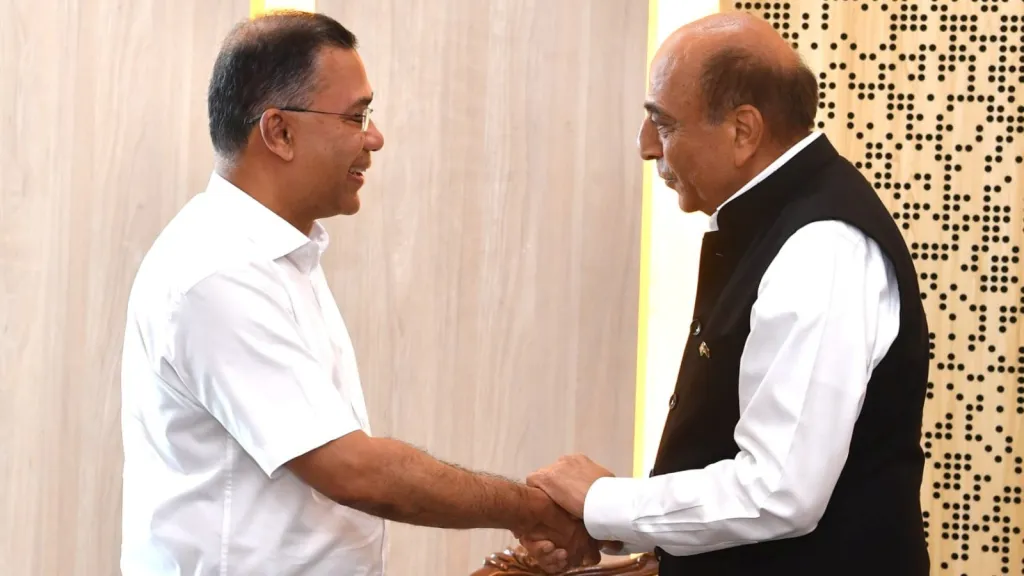
Prof. Syed Munir Khasru The Indian ExpressSeptember 8, 2026 https://indianexpress.com/article/opinion/columns/high-commissioner-dinesh-trivedi-delhi-dhaka-sheikh-hasina-10868293 Visas, borders, water, trade and extradition are ultimately matters of policy. Dinesh Trivedi’s diplomacy can create momentum; whether the reset advances, and whether Tarique Rahman visits India, will depend on what Delh
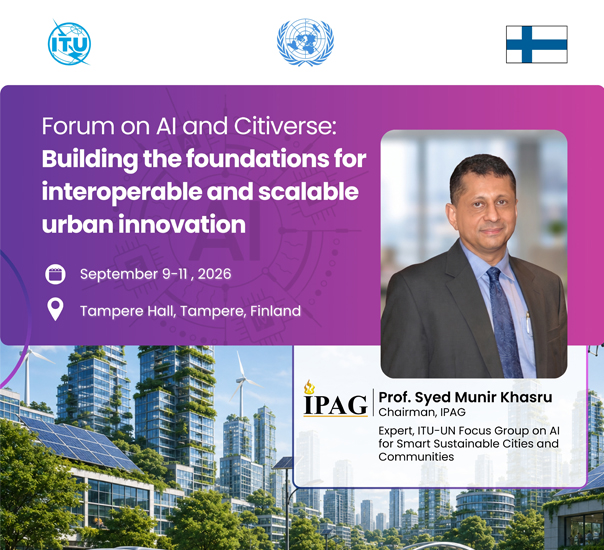
Prof. Syed Munir Khasru, Chairman of the Institute for Policy, Advocacy, and Governance (IPAG), will participate in the ITU Forum on AI and Citiverse 2026 in Tampere, Finland. Following IPAG’s engagement at the AI for Good Global Summit 2026 in Geneva, this participation continues its work on inclusive AI governance, digital transformation, and people-centred approaches […]
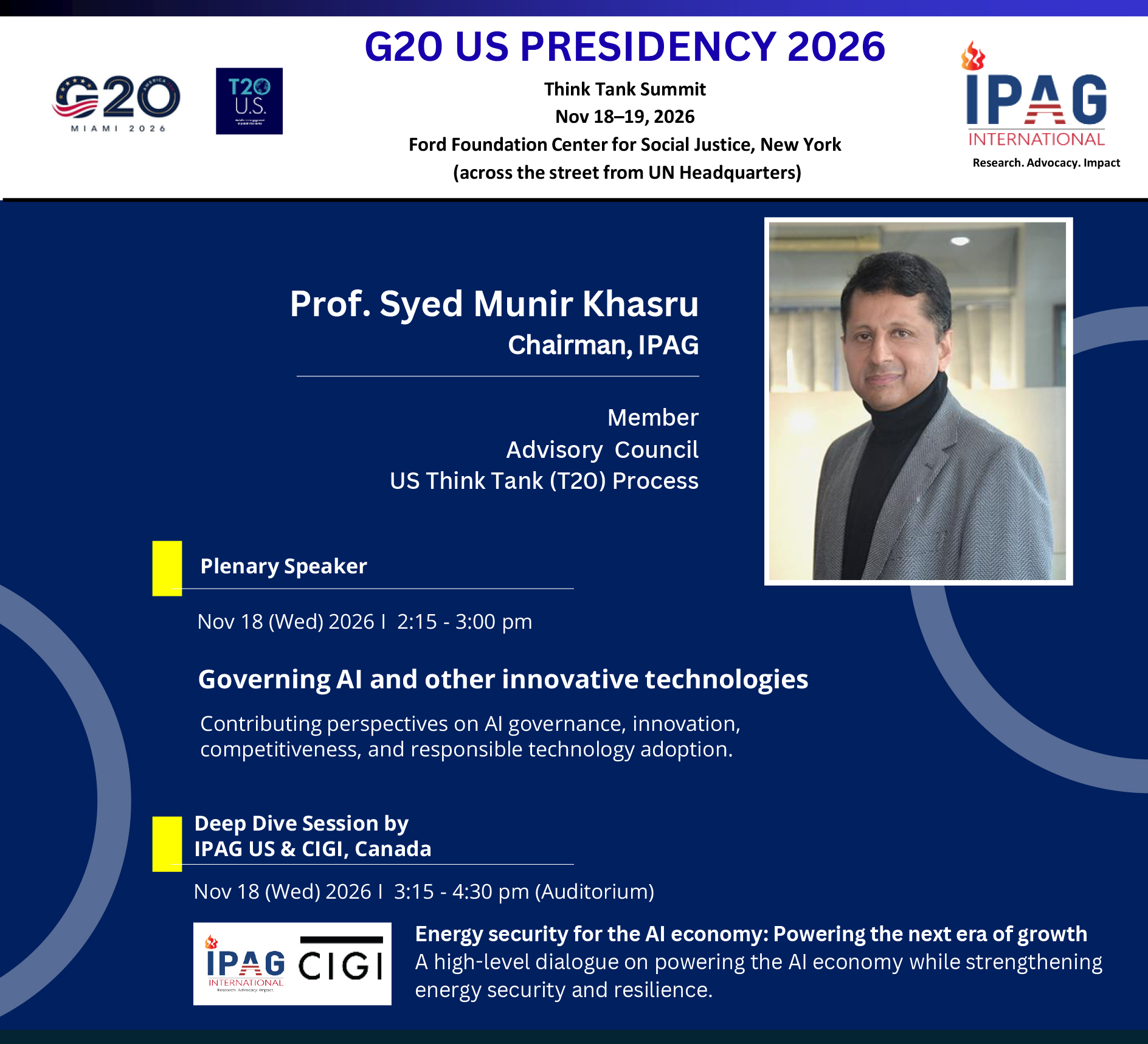
With the US G20 Presidency 2026 now underway, the world’s largest economy is setting the stage for a consequential year of global decision-making on growth, innovation, energy security, trade, and finance. The process will culminate in the G20 Leaders’ Summit in Miami, Florida, on December 14–15, 2026 bringing together the leaders of the world’s major […]


0 Comments