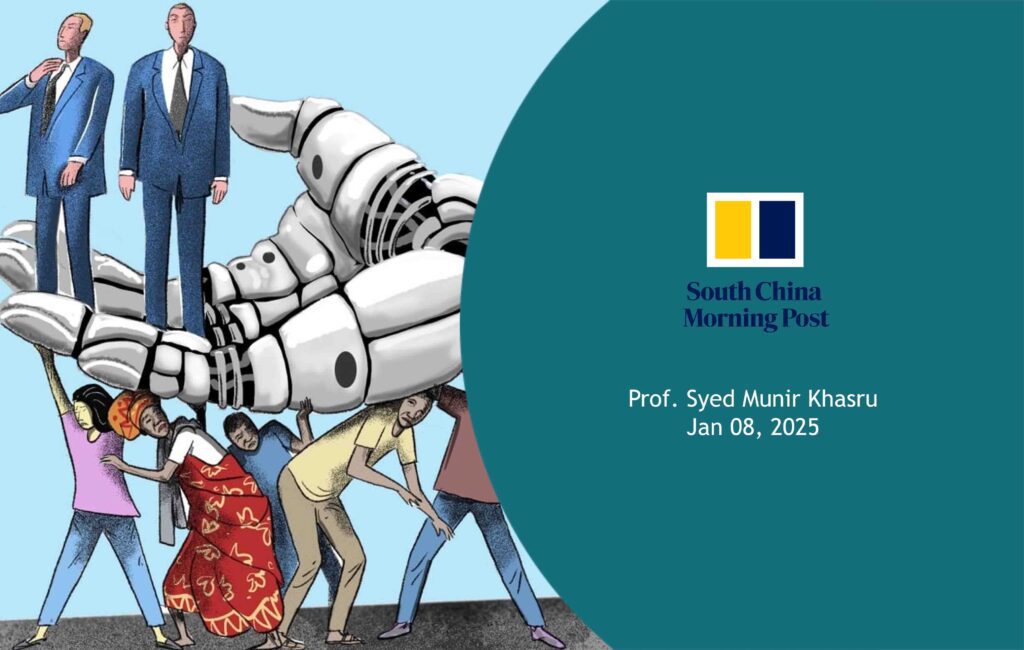
Artificial intelligence (AI) has the potential to be a transformative force, reshaping industries, economies and societies while acting as a harbinger of revolutionary change. However, UN Secretary General Antonio Guterres cautioned the UN Security Council in a recent address that this technological revolution carries a double-edged promise: while it has the potential to drive progress, it also risks deepening existing inequality.
His urgent call that “we must never allow AI to stand for advancing inequality” is not just valid, it demands immediate global action. The critical question is how the international community can harness AI’s potential responsibly while safeguarding against its pitfalls.
AI advocates emphasise its potential to solve global challenges, from addressing food insecurity to predicting climate change-induced displacements. However, this optimism is tempered by the rapid speed of AI’s development, which can outpace the frameworks necessary for its governance.
As Guterres highlighted, AI’s deployment in autonomous weapons, border surveillance and predictive policing raises profound ethical and legal questions. Beyond these immediate concerns, AI’s integration into economic systems is reshaping labour markets and deepening existing divides between the global North and South.
In developed economies, AI promises economic growth and productivity gains. McKinsey’s assessments suggest AI could contribute US$4.4 trillion annually to the global economy, yet these benefits are not equitably distributed.
Developed regions and countries are in position to capture the lion’s share of gains, leaving the Global South scrambling to catch up. This is a worrying indicator of what could happen if AI remains unchecked. Likewise, PwC predicts that Africa, Oceania and less-developed parts of Asia – regions already facing significant development challenges – will see only minimal economic returns from AI.
The rapid development in AI-enabled automation is expected to affect 40 per cent of jobs worldwide, having a particularly negative impact on those in low-skilled or repetitive roles. Developing nations, where economies often rely on manual labour, are particularly vulnerable.
Moreover, while AI technology can transform productivity in hi-tech sectors, it often excludes under-represented populations because of design biases. AI tools trained predominantly on English-language data can fail to address the needs of non-Western users, rendering such tools ineffective or even harmful in local contexts. As a result, these challenges exacerbate existing inequalities for countries with limited digital infrastructure and internet access, further sidelining the Global South.
Besides economic disparities, AI poses significant environmental and security risks that could place much of the world population at a disadvantage. Most data centres powering AI models heavily rely on fossil fuels and contribute to a growing carbon footprint. Data centres and transmission networks are responsible for 1 per cent of energy-related global greenhouse gas emissions.
In terms of security, AI’s employment in autonomous weapons and cyberattacks represents a rather apocalyptic erosion of human control over the use of force. Given that, Guterres’ plea to ban lethal autonomous weapons by 2026 is understandable. There must be real urgency to establish international safeguards for the preservation of peace and human rights.
About 32 per cent of the global population, or 2.6 billion people, lack internet access, with most of them concentrated in the Global South. In this context, developing countries often grapple with acquiring equitable access to digital tools and infrastructure as they lack adequate capacity or the infrastructure needed to use AI for development.
To address these challenges, it is vital to advocate for the Global Digital Compact, emphasising inclusive AI governance. The compact’s focus on capacity-building and technical assistance for developing countries is particularly crucial as it aspires to avert the emergence of a new AI divide. If employed fairly and holistically, this initiative will succeed in creating a universal framework that ensures AI serves humanity.
AI bias disproportionately harms non-native speakers, black people and women, perpetuating harmful stereotypes and inequalities. For example, in the United States, an investigation by a non-profit news organisation found that AI-driven algorithms were 80 per cent more likely to reject mortgage applications from black families, perpetuating historical discrimination.
Similarly, during the Covid-19 pandemic, an AI system downgraded 39 per cent of assessments of A-level grades by teachers in England, disproportionately affecting students in disadvantaged schools. After a public outcry, the AI system’s grading was disregarded.
AI algorithms also often misidentify the written work of non-native English speakers as AI-generated, leading to false accusations of cheating and discouraging their academic contributions.
Similarly, there are instances where AI systems reflect societal gender biases, associating roles such as “secretary” or “flight attendant” with women while linking professions such as “judge” or “lawyer” to men, reinforcing outdated stereotypes. Such biases marginalise these groups and perpetuate systemic discrimination in education and beyond.
There is a dire need to establish inclusive and secure governance mechanisms to ensure AI technologies are developed and deployed responsibly. Multilateral organisations and governments must work in unison with the help of experts. Critical steps include banning lethal autonomous weapons to maintain international peace and security and bridging the digital divide in the Global South by investing in digital infrastructure and education.
Promoting ethical AI design is equally essential; developers must prioritise inclusivity, fairness and transparency to address biases. Additionally, strengthening international collaboration is vital to tackling AI’s cross-border implications.
All in all, Guterres’ concerns about AI’s potential to exacerbate inequality are well-founded. However, with proactive governance and global cooperation, AI can become a force for good. By aligning its development with principles of equity, sustainability and human rights, we can create a future where AI lifts up all of humanity, not just a privileged few.
Prof. Syed Munir Khasru NIKKEI AsiaApril 3, 2026 https://asia.nikkei.com/opinion/asia-s-next-economic-crisis-may-come-from-youth-unemployment For years, policymakers across Asia have focused on sovereign debt as the region’s most visible economic risk. But the next crisis may not begin with government balance sheets but with a generation of young people unable to find work. Even as governmen
Prof. Syed Munir Khasru The Indian ExpressMarch 10, 2026 https://indianexpress.com/article/opinion/columns/west-asia-war-india-remittances-energy-hormuz-trump-oil-khamenei-10574030 The West Asia conflict may be unfolding thousands of miles away, but for South Asia, its economic consequences are uncomfortably close. The region’s external stability is deeply intertwined with West Asia through two
Prof. Syed Munir Khasru Hindustan TimesMarch 31, 2026 https://www.hindustantimes.com/opinion/a-silence-that-keeps-raw-bangladesh-s-1971-wounds-101774969898030.html Bangladesh Prime Minister (PM) Tarique Rahman’s remarks on the 1971 war on March 26, the country’s Independence Day from the erstwhile West Pakistan, have reignited a question that has never fully settled in Bangladesh’s public co




0 Comments